

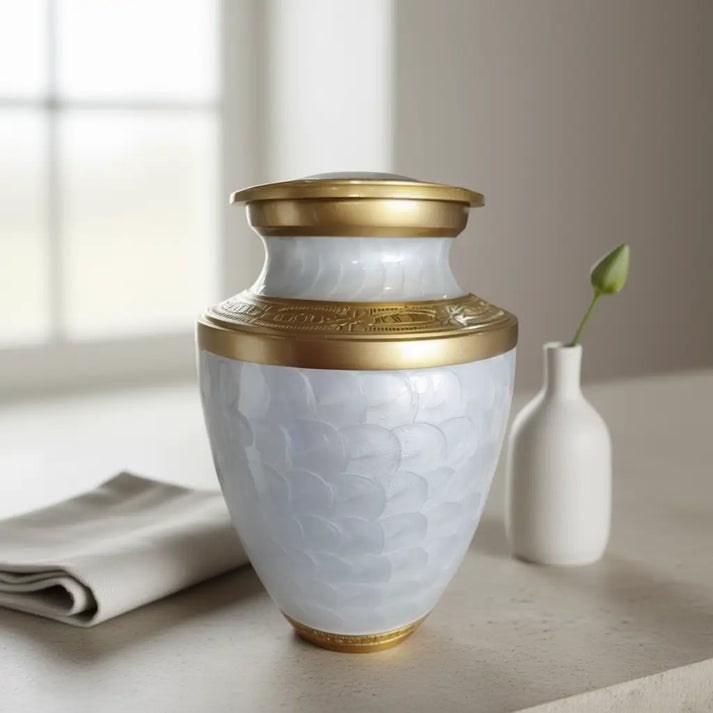

Cremation urns crafted for NZ families
Free express shipping NZ wide. Every urn arrives carefully packaged and ready to receive.

Cremated ashes are known for their longevity, often lasting indefinitely when stored in a well-sealed urn. Many people wonder, how long do cremated ashes last in an urn? The answer depends on storage conditions, urn materials, and environmental factors.
For centuries, cremated remains have been preserved in cremation urns, columbariums, and family homes. Unlike organic matter, cremated ashes do not decompose, as they are made up mostly of calcium phosphate and other minerals. This makes them highly resistant to decay.
Cremated remains, commonly referred to as ashes, are not really ash at all. They are the bone fragments left behind after cremation, which are ground into a coarse, sand-like texture. The extreme heat of cremation removes all organic matter, leaving only minerals such as calcium phosphate behind.
Cremation takes a few hours. Afterwards, a loved one's ashes are processed into fine granules and returned to the family, usually in a temporary container or sealed ashes box. From there, the ashes can be placed in a biodegradable, ceramic, wooden or metal urn, depending on the family's wishes.
Some may choose to scatter the ashes, while others keep them in an urn for a lifetime. Archaeologists have found cremated remains that are thousands of years old, showing that cremated remains can last indefinitely under the right conditions.
When buried in the ground, cremated remains can last a lifetime or much longer, depending on the conditions. Soil type, moisture levels and burial depth all affect how quickly ashes may break down.
If buried in a biodegradable urn, the ashes will gradually return to the earth over time.
When placed directly in the soil, they can remain intact for decades or even centuries.
Wet or acidic soil can speed up the breakdown process.
It is highly recommended to talk with your funeral director or local council before burying ashes, as many cemeteries and public places require permission. Families wishing to keep their loved one’s remains protected in the ground for generations may choose an urn made of durable materials, such as brass or marble. Our guide to choosing the best urn material compares the options.
Ashes behave very differently in water than in an urn. They don't dissolve. Instead, they sink, spread out and settle, gradually becoming part of the riverbed, lakebed or seabed. Here’s what happens in different bodies of water:
Lakes & Rivers – Ashes settle and are slowly carried and spread by the current.
Oceans – Waves and tides quickly spread the ashes over a wide area.
Scattering Ashes – When ashes are released onto water, they begin dispersing immediately and become part of the natural environment.
For a gentler farewell on water, biodegradable water urns are an excellent option. They float briefly before slowly sinking and breaking down, releasing the ashes naturally. Check with your local council before scattering ashes in water.
When kept at home, ashes inside an urn can last for decades or even centuries. The longevity depends on:
Urn Material – Metal and ceramic urns provide better protection than wooden or biodegradable urns.
Storage Conditions – Keeping the urn in a cool, dry place away from direct sunlight protects it from moisture and air pollutants.
Sealing Methods – A well-sealed urn with a secure, threaded lid keeps the ashes safe and free from contamination.
Some families choose to place a loved one's ashes in a display urn at home, while others choose a more permanent location, such as a columbarium or family vault. There is no expiry date on ashes when stored properly, making them a lasting memorial for generations.
What is a columbarium? A columbarium is a building or wall, usually at a cemetery or crematorium, with small compartments called niches where urns are placed. Some niches are open with a glass front, while others are sealed and finished with a plaque.
A columbarium is one of the best places for long-term storage of cremated remains. Ashes stored in a columbarium can last indefinitely, as they are shielded from moisture, soil, weather and air pollutants. Unlike burial, where the remains interact with soil and water, a columbarium keeps the urn protected and preserved.
Many factors affect the longevity of ashes, but columbarium niches offer one of the best ways to keep them intact.
Some columbariums offer sealed niches, providing extra protection against environmental damage.
Families can visit their loved one’s ashes in a columbarium, ensuring a dignified and permanent tribute.
Choosing an urn for a niche: niche sizes vary between cemeteries and there is no standard size, so always ask for the niche measurements before you buy. Our guide to choosing a cremation urn explains what to check. Compact metal urns with secure lids are a popular choice for niches.
Here are some interesting and lesser-known facts about cremated remains:
Cremated ashes are not actually ashes – They are made up of ground bone fragments and minerals, rather than soft ash.
Cremains can last forever – When stored properly in a sealed urn, cremated remains do not break down over time.
Cremation dates back thousands of years – Many ancient civilisations, including the Greeks and Romans, practised cremation.
Adult ashes usually weigh around 2 to 3 kilograms – The total weight depends on the individual's body size and bone density.
Cremated remains are mostly minerals – Mainly calcium phosphate, with small amounts of others such as potassium and sodium. The heat of cremation destroys usable DNA.
Ashes can be turned into keepsakes – Small amounts can be made into memorial glass, jewellery or even lab-grown diamonds.
Space memorials are possible – A small portion of ashes can be sent into space for a unique tribute.
Cremains can be mixed with paint – Artists can incorporate a small amount of ashes into paint to create memorial portraits or artwork.
Cremated ashes can last indefinitely when stored in the right conditions. Whether kept in an urn at home, buried in the ground, scattered on water or placed in a columbarium, their longevity depends on the urn material, how they are stored and how exposed they are to the elements.
For those wondering how long cremated ashes last in an urn, rest assured that with proper care they can endure for centuries. Whether you choose to keep the ashes, scatter them or place them in a columbarium, each option is a lasting way to honour your loved one.
For help selecting the right urn, visit our cremation urn collection or read our complete NZ guide to choosing a cremation urn.